
Loading…
Agent Studio
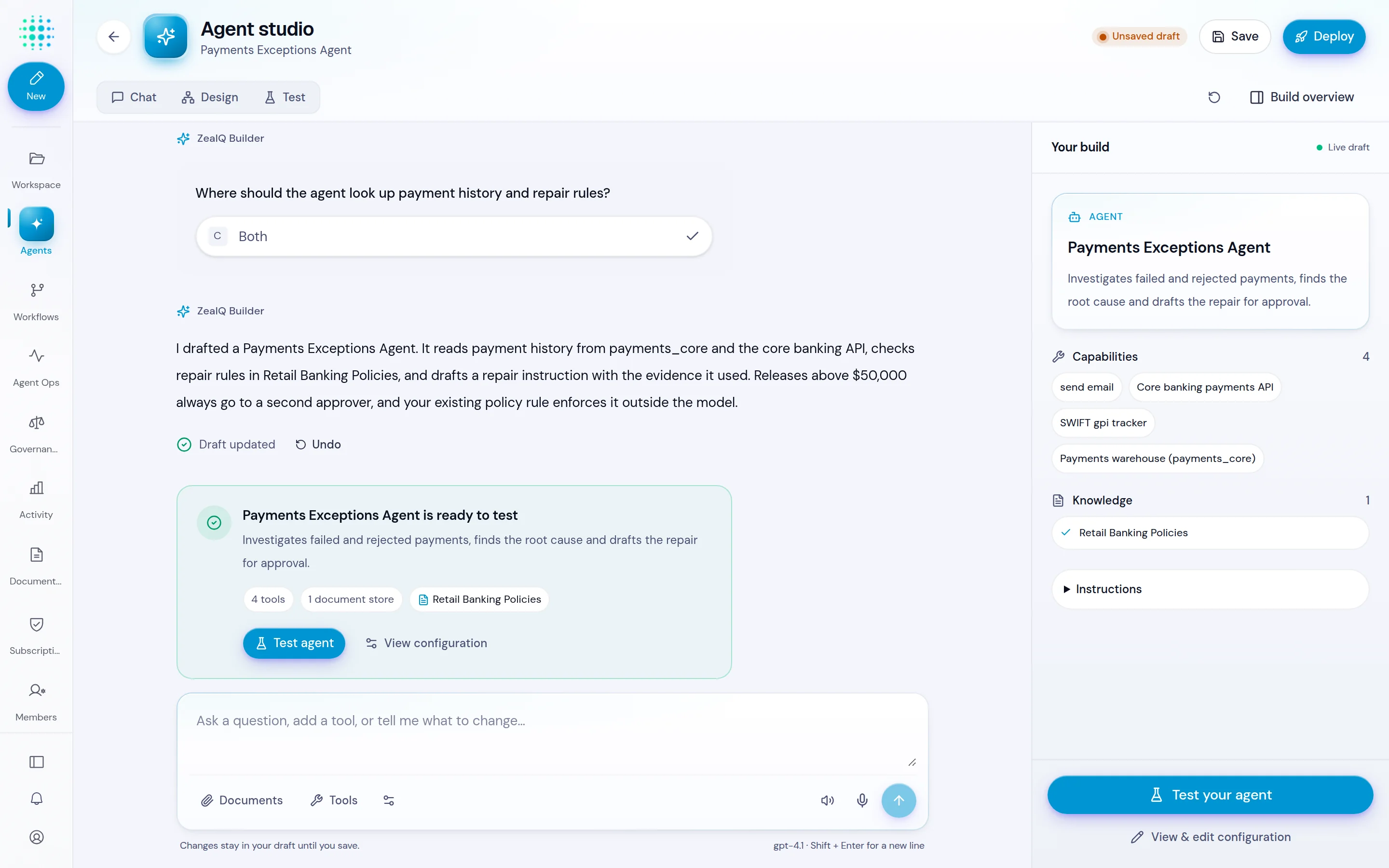
Agent Studio turns a conversation into a configured, tested agent — instructions, model, tools, knowledge, memory and guardrails — and keeps a full manual editor one click away for the details.
Capabilities
Chat, Design and Test views side by side. The studio asks clarifying questions, drafts the configuration and lets you undo any change it proposes.
PDF, Word, Excel, PowerPoint, CSV, HTML and more are uploaded, indexed and attached to the agent in a single step.
Built-in SQL, web search, browser, email and SharePoint tools, plus HTTP webhooks, OpenAPI specs and MCP servers as custom tools.
Package instructions, resource files and scripts as skills with typed arguments. Scripts run only after approval.
Sandboxed Python with code, output, figures and files shown right in the chat, when the model supports it.
Security filter, PII redaction and a guardrail activity log — switched on by default in Guarded mode.
How it works
Tell the studio what the agent should achieve, who it serves and which systems it can touch.
See the proposed instructions, model, tools and knowledge. Accept, edit or undo each change.
Run real conversations in the Test panel against the draft before anything is published.
Send the agent through your publish gate and expose it to chat, channels, API, A2A or MCP.
Full control when you need it
The agent editor shows the complete anatomy of an agent with a setup checklist and an issues pill that jumps straight to anything that needs fixing.
Agent anatomy
Start from proven patterns
Begin from templates such as Browser Operator, Vendor Portal Clerk, Support Ticket Triager, Contract Reviewer, SQL Analyst, Claims Intake and Patient Intake — then make them yours.
Agent templates
Under the hood
The specifics your architects and security reviewers will ask for.
Works with
Every capability shares the same runtime, identity and governance.
No. Create with AI, the manual 3-step wizard and templates all produce the same agent, and every setting stays editable in the agent editor.
Any model from the nine supported providers, including private and sovereign options such as Ollama, ZeaLLM and Core42 Compass. Each organization can bring its own provider keys.
Yes. Import an OpenAPI spec and each operation becomes a tool, or connect an HTTP webhook or MCP server. Credentials are stored encrypted in the org vault.

Book a working session with our team. Bring a real use case — we'll build it with you and show the governance and ROI views alongside.