
Loading…
Agent Ops
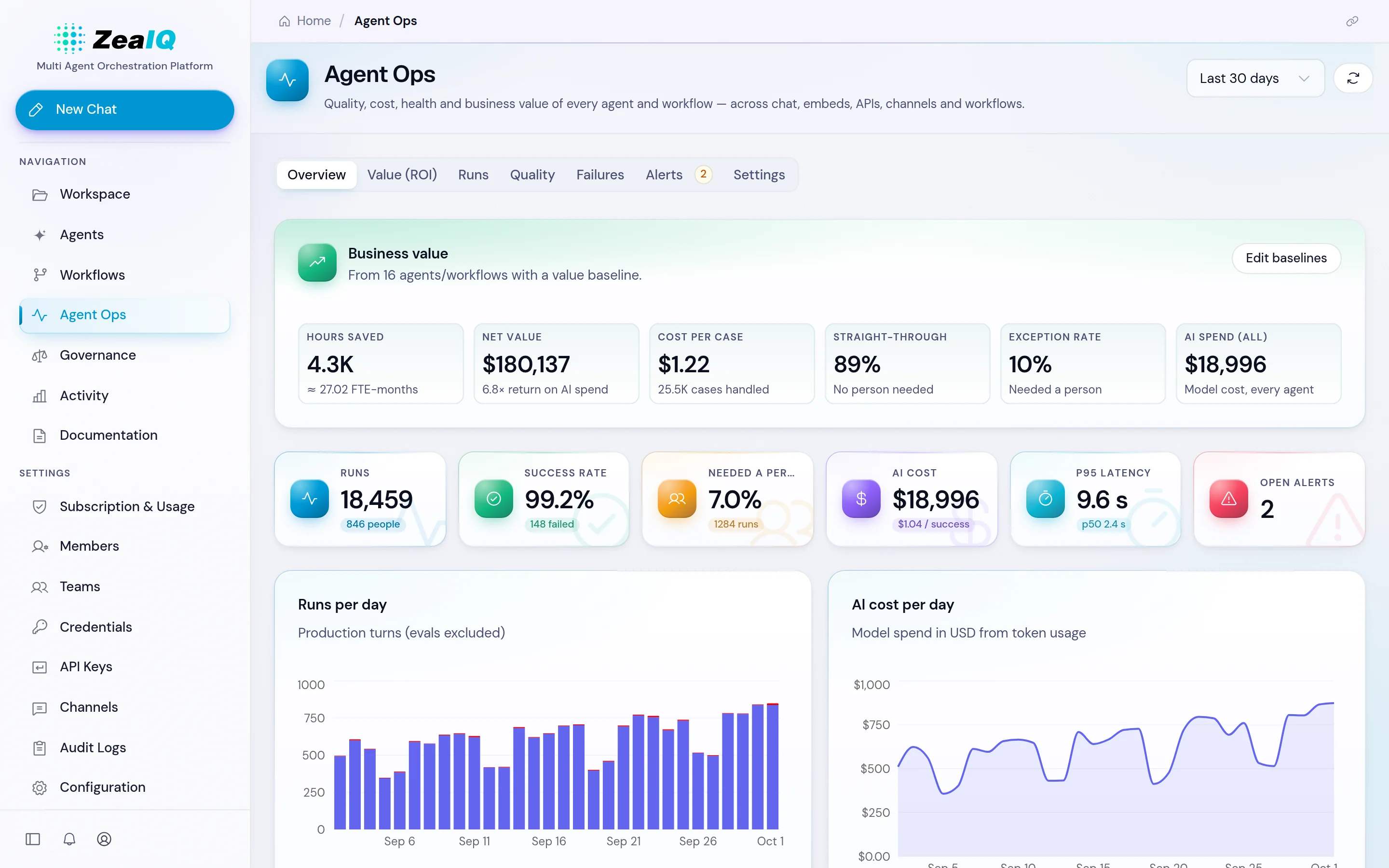
One ledger for every agent turn on every surface, with evals, live quality sampling, health alerts, failure clustering and the business value each agent delivers.
Capabilities
Model, tokens, cost, latency, time to first token, tool calls, errors and human involvement — for every turn.
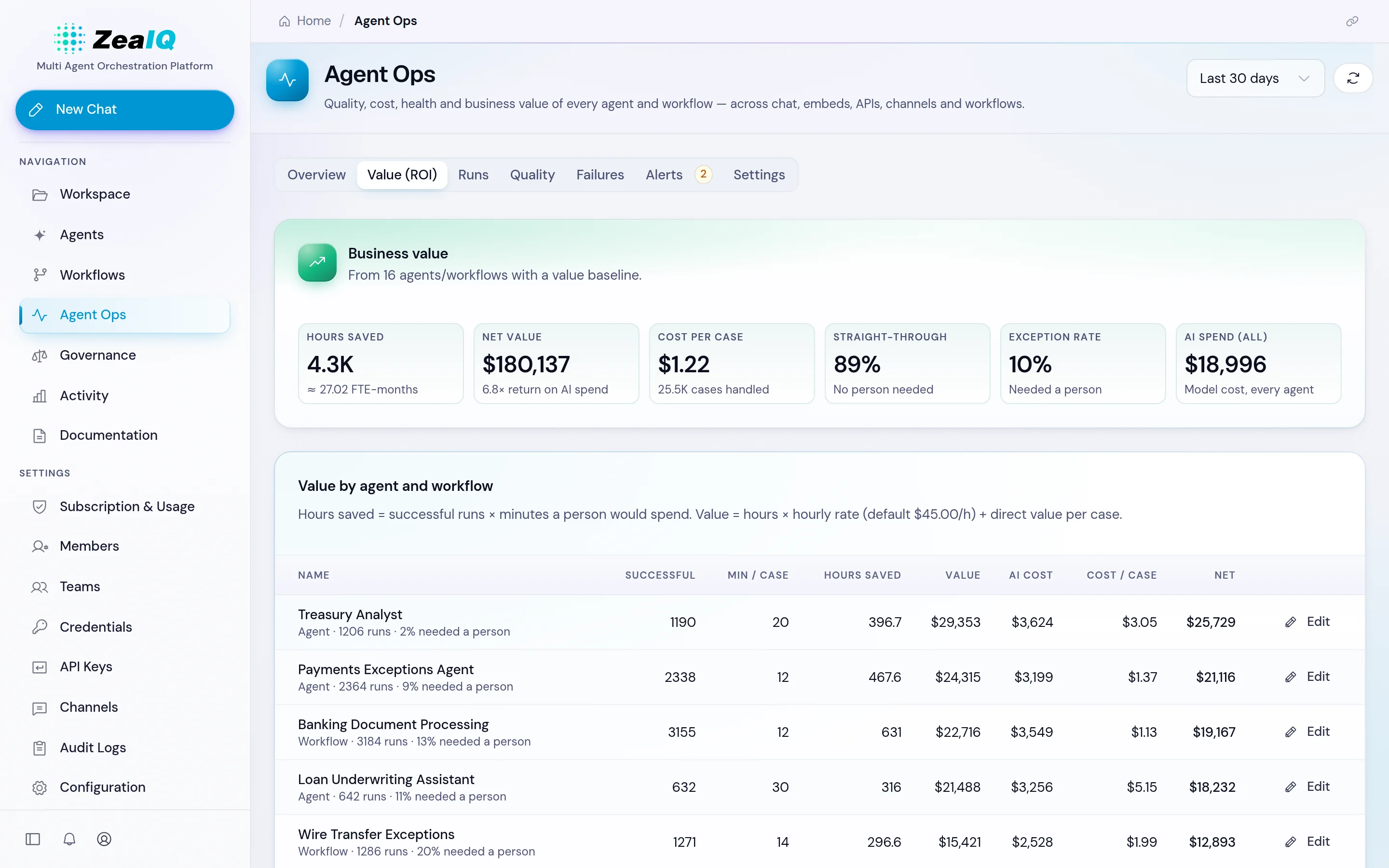
Set value baselines to see hours saved, FTE equivalent, net value, ROI multiple, cost per case and straight-through rate.
Weighted rubric judges, deterministic checks, multi-turn cases and LLM-simulated users. Any production run becomes a regression test.
A judge model scores a sample of production runs every hour on a 0–1 scale.
Error rate, p95 latency, tool errors, daily budget, live quality and eval regressions — by email or Slack, with optional auto-suspend.
Errors grouped by signature with suggested fixes for timeouts, rate limits, auth, context size and bad arguments.
How it works
Every surface writes to the ledger: chat, API, embed, channels, MCP, A2A, teams and workflows.
Gate releases with eval suites and sample live quality every hour.
Deduplicated, self-resolving alerts reach the right people before users notice.
Report hours saved and ROI per agent and workflow.
Prove the business case
Give each agent or workflow a baseline — minutes per case, loaded hourly rate, direct value per case — and Agent Ops calculates the value of every production run.
Under the hood
The specifics your architects and security reviewers will ask for.
Works with
Every capability shares the same runtime, identity and governance.
You choose. Capture can be full, redacted with PII masked, or metadata only.
From baselines you set per agent or workflow — minutes per case, hourly rate and direct value — applied to real production runs, net of AI cost.

Book a working session with our team. Bring a real use case — we'll build it with you and show the governance and ROI views alongside.